-
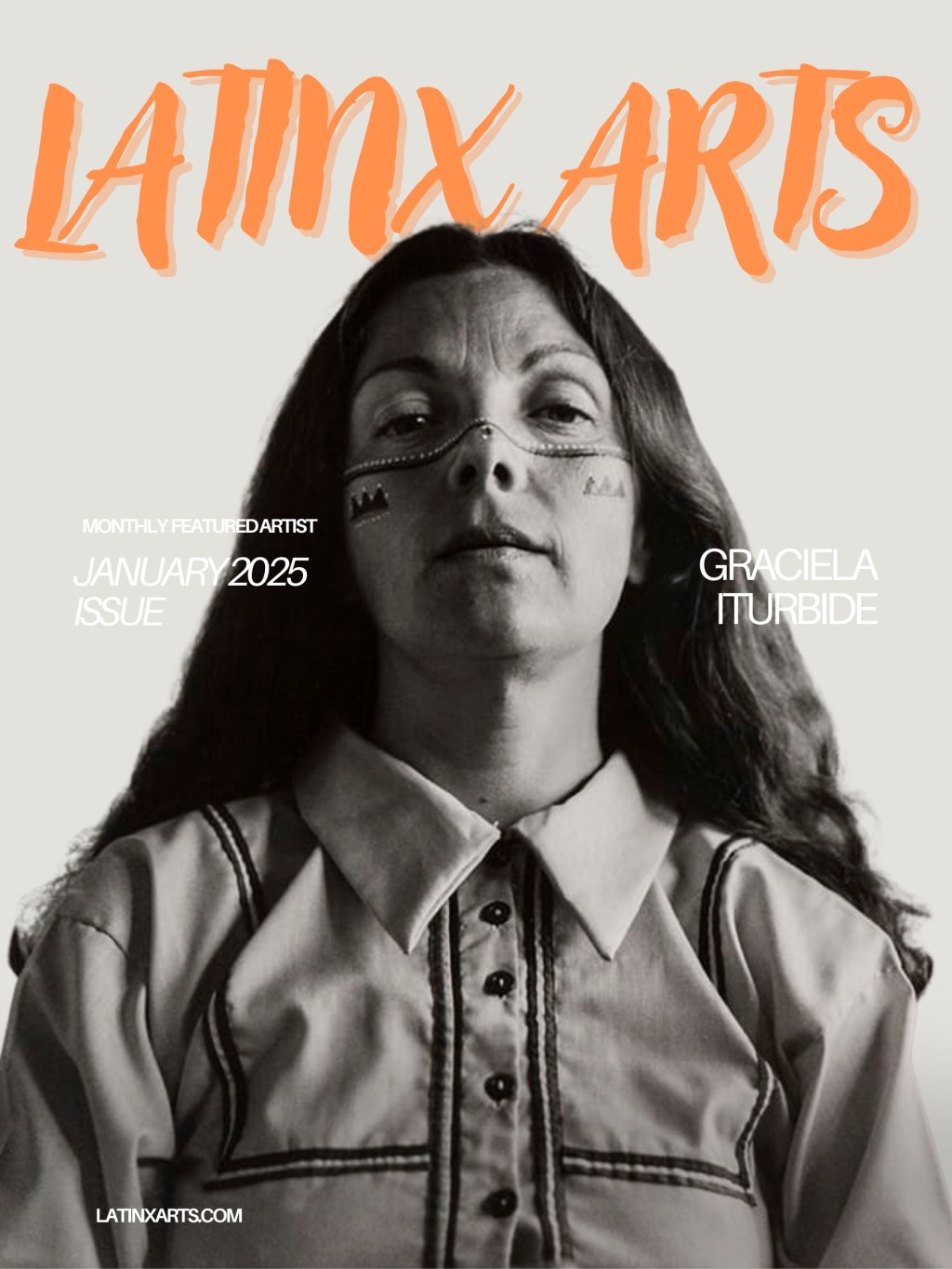
Iturbide (she/ella) is a world-renown Mexican photographer who captures the poetic cadencia (cadence) that echoes throughout México, specifically resonating with Indigenous pueblos. Iturbide’s initial interest in film led the artist to her mentor, Manuel Álvarez Bravo (el Maestro), who influenced Graciela’s photo-journalistic approach with communities. The photographer’s entire scope of work is an endearing love-letter to
-

Báez (she/ella) is an Afro-Caribbean and Afro-Latino/x artist who lives and works in New York, producing a magnitude of oeuvres that speak to the African diaspora through her dream-like style. The artist often uses archival maps that were used during the colonization period as a base for their works, linking the past and present together.
-
Rivera (she/ella/elle) is a French-Peruvian photographer, entrepreneur, and fashion-icon based in Paris, dedicated towards creating spaces for the Latinx/o community in the Parisian region and beyond. Often using herself as the subject of her own vision, her unique style consists of adornments of traditional Peruvian patterns and colors, gold and organic jewelry, and the sacred
-
Yolanda Lopez (b.1942 – 2021; she), a Mexican American painter whose artwork and activism during the Chicano Movement, continues to be studied by generations throughout institutions and contemporary Latinx/o artists. Yolanda was raised in Barrio Logan, San Diego, and pursued higher education in the Bay Area where she witnessed an echo of systemic oppression. The
-
Cuevas (he/they/she) is a multidisciplinary, Latinx SoCal artist whose work explores the fluidity that is found in the queer, femme, and non-binary experience. The artist primarily uses fiber, a malleable material, to open dialogue between the viewer and the subconscious. Cuevas frequently abstracts from themes of gender, anatomy, and queer history, placing these snippets into
-
Zapata (she/her) is a Texas-born textile artist who resides in NYC and teaches at Yale University. As a first-generation Peruvian-American queer Latinx, her works are abstractions of personal experience. She incorporates patterns and pre-colonial traditions in her works, more specifically from the Paracas and Nazca cultures of Peru. Zapata is purposeful when it comes to
-
Dubbed as, “The Extremist of Performance Art”, Martiel uses the human body to quite literally deepen wounds that are experienced by “others,” who are vulnerable to the longevity of colonialism. The artist fully immerses themself into the concepts at hand, often physically harming their own body as part of their creative process. Writer’s Commentary What
-

Polvo de Gallina Negra: 40 Años de Polvo de Gallina Negra. Arte Feminista en México During my visit to el Museo Cabañas, I was able to see an exhibition of the feminist art collective, Polvo de Gallina Negra (below on left). This exhibition was curated by Julia Antivilo Peña and María Laura Rosa. I must
-
It has been in my personal and academic experience that many have a negative idea when it comes to using “Latinx” rather than “Latino/a”. It is important to remember that utilizing either or is up to personal preference and neither choice is wrong. Let us first define some terminology: As you may have gathered by
-
“Art is not what you see, but what you make others see.” – Edgar Degas In recent years, the art scene in the IE has improved significantly. The representation and variety of work is aligning very closely with the people who live there. It’s refreshing to have seen this shift take place and even more

 Latinx Arts